Buying Guides
A Preloaded Card Promises Fifteen Thousand Games. The Handheld It Ships With Clears Seven Systems.
Listings for a $40 handheld promise fifteen thousand games. The grade index says the cheap tier clears a B on seven of eighteen systems either way.
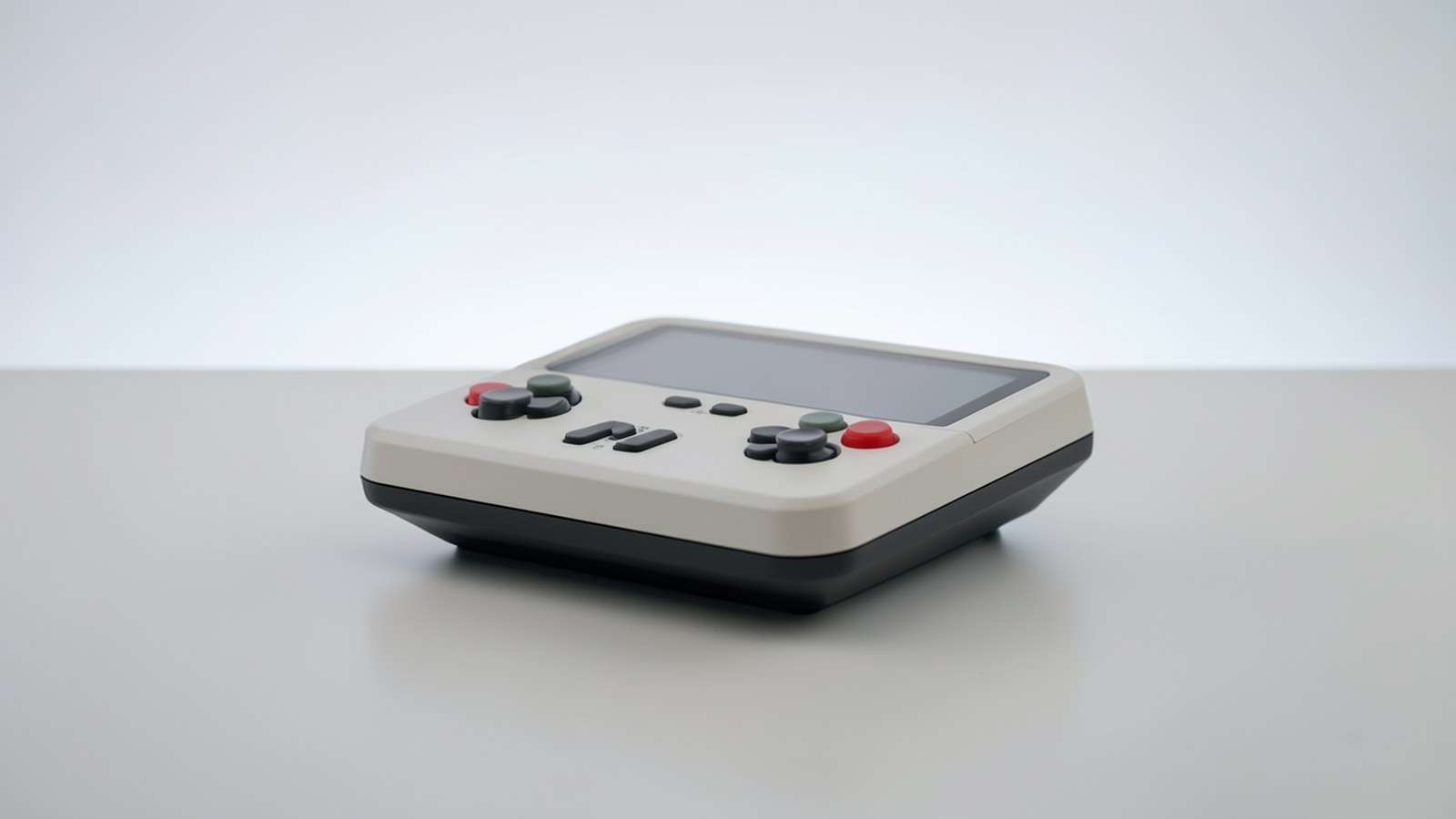
A reseller that sells the R36S with a 64GB ArkOS card describes the bundle as "15,000+ preloaded ROMs" and claims 12,805 searchable titles on the card. A Geekbuying listing for the Anbernic RG35XX Plus puts "Games Pre-installed" in the product copy and "ROM: 64GB TF/MicroSD" in the spec block. The RG35XX family and the R36S are different machines from different manufacturers, and their listings make the same promise in the same words.
All of them describe the same two things, and neither of them is performance. One is a card. The other is a fixed piece of hardware that will be identical whether you buy it with the card or without it.
That distinction matters more than any game count, because the count describes a directory listing and the hardware describes what you can play. Our catalogue grades 593 retro handhelds against the same eighteen systems on one scale. Of those, 445 carry a grade for every system. Read against that set, the preloaded promise stops being a feature and turns into an arithmetic problem.
What "preloaded" actually describes
A preloaded handheld is a console plus a MicroSD card that has been written with an emulator front-end, a set of emulator cores and a folder tree full of ROM files. Nothing about the console changes. The 64GB in the Geekbuying listing for the RG35XX Plus is described in the spec block as "ROM: 64GB TF/MicroSD", which is the storage medium, not a capability.
That is why two listings of the same device can quote wildly different libraries. The number on the box counts files, and a file set can include regional duplicates, bootlegs, hacks, prototypes and titles in three languages. The reviewer at Infoquu, working through a retail R36S, put it plainly: the library is big, "but a lot depends on the quality of the games... not all preloaded ROMs are high quality". The same review notes the card "wasn't the highest quality" and that the common advice is to replace it.
Buy the console, then decide what goes on the card — because the card is the only part of the bundle you can replace.
The card does not change what the chip can do
Every grade in our index is measured, not inferred from a spec sheet, and it is per system. Take the five handhelds that dominate preloaded listings between $40 and $90. This is what each clears at B+ or better across all eighteen tracked systems:
| Device | Tracked price | B+ or better | Systems it clears |
|---|---|---|---|
| R36S | $40 | 7 of 18 | Game Boy, NES, Genesis, GBA, SNES, PS1, DS |
| Anbernic RG35XX (2024) | $50 | 9 of 18 | the seven above, plus N64 and Dreamcast |
| Miyoo Mini Plus | $70 | 7 of 18 | Game Boy, NES, Genesis, GBA, SNES, PS1, DS |
| TrimUI Smart Pro | $80 | 9 of 18 | the seven, plus N64 and Dreamcast |
| Powkiddy X55 | $90 | 9 of 18 | the seven, plus N64 and Dreamcast |
Two facts fall out of that table.
The first is that a $70 Miyoo Mini Plus clears exactly the same seven systems as a $40 R36S. The extra $30 buys a better screen, a better shell and a much better operating system — OnionOS is the reason people buy it — but it buys no additional coverage, and it grades an F on the Nintendo 64 where the cheaper R36S grades a C.
The second is that the whole $40-to-$90 band tops out at nine systems. Two systems separate the cheapest device in the group from the most expensive one.
What the $40 tier can already run
The seven systems every one of those devices clears are the ones the preloaded library is mostly made of: Game Boy, NES, Genesis, Game Boy Advance, Super Nintendo, PlayStation and Nintendo DS. That is not a knock. It is most of the retro catalogue people actually search for, and it is why a $40 handheld feels like a bargain on the first evening.
Set that against the full index and the shape of the problem becomes visible. Of the 445 graded handhelds, the share that clears a B or better on each system is:
| System | Devices at B+ or better | Share of 445 |
|---|---|---|
| Game Boy | 439 | 99% |
| NES | 440 | 99% |
| Genesis | 410 | 92% |
| Game Boy Advance | 377 | 85% |
| Super Nintendo | 365 | 82% |
| PlayStation | 346 | 78% |
| Nintendo DS | 233 | 52% |
| Nintendo 64 | 209 | 47% |
| Dreamcast | 172 | 39% |
| PSP | 171 | 38% |
| Saturn | 149 | 33% |
| GameCube | 133 | 30% |
| 3DS | 129 | 29% |
| PlayStation 2 | 118 | 27% |
| Wii | 117 | 26% |
| Wii U | 80 | 18% |
| Switch | 65 | 15% |
| PlayStation 3 | 44 | 10% |
The card in the box does not care about that table. A ROM set large enough to reach fifteen thousand files will include PSP, Dreamcast, Saturn and GameCube content, because those libraries are where the file count grows fastest per title. On the $40-to-$90 hardware that sells those cards, PSP grades a C to F, Saturn a D to C-, and GameCube an F. Those games are on the card and they are not playable, or they are playable at a frame rate that makes the first ten minutes look like a compatibility problem rather than a hardware limit.
Paying more does not buy systems until it buys a different chip
The coverage ladder is not smooth, and it is not where the preloaded listings suggest it is. Fifteen of the eighteen tracked systems are playable from $114, seventeen from $299, and the eighteenth — the PlayStation 3 — does not appear until $599, on Windows handhelds only. That is the subject of its own analysis of coverage against price, and it explains why the useful question at $40 is not "how many games" but "which of the eighteen".
Inside the preloaded bracket, the answer barely moves: 7 systems at $40, 9 at $50, 7 at $70, 9 at $80, 9 at $90. What moves is everything around the emulation — screen, controls, battery, firmware support. Those are real reasons to spend more. A larger card is not one of them: the card is a separate line item in the same listings, sold in capacities from 32GB to 512GB, and nothing about it changes the eighteen grades above.
Where the promise breaks: the card itself
Two failure modes show up in reviews of preloaded hardware far more often than emulation problems, and neither is fixed by spending another $20 on the console.
The card is the cheapest component in the bundle. The Infoquu review of a retail R36S describes replacing the bundled card as the standard remedy for stability issues, and community firmware guides for the same device assume the user is writing a fresh image to a new card — the R36S custom firmware instructions begin with flashing an image to a fresh SD card and then swapping a device-tree file inside the boot partition. You cannot follow that guide without abandoning the card the console arrived with.
The console may not be the console. The same review flags clone units sold by drop-shippers, where the firmware is not the one the listing names. A preloaded card is unusually good camouflage for that, because the first thing a buyer sees is a working library of games rather than a chip that does not match the spec sheet.
The catalogue page for each device is the check that costs nothing: the hardware identity, the OS and the eighteen grades are the same fields regardless of what the seller wrote on the listing. How the grades are assigned explains the scale; the full per-system matrix lists every device.
The part of the listing that is not about games at all
Preloaded handhelds are also the one product category where the shipping label has become a policy argument. The Entertainment Software Association's comment in the USTR's 2026 Notorious Markets docket asks for a border remedy in as many words: "improve customs targeting for devices and components associated with preloading operations". Another filing in the same docket — from a pay-television operator, writing about a different product entirely — explains why that is hard: where preinstallation happens after import, "the devices may present as unremarkable consumer electronics at the point of entry, which complicates detection by customs and other authorities". We read all 57 comments in that docket in one filing says customs cannot see a preload.
For buyers, the practical consequence is the same one the enforcement discussion keeps running into: the preload is the transferable part. RetroDodo's reporting on a Lenovo handheld reaching Western buyers through AliExpress with Nintendo and SEGA titles installed is the clearest recent example. Lenovo's statement to the outlet was that there is "no game content preloaded on this device as sold in PRC, nor are there any memory cards that ship with the device from Lenovo or its authorized licensees", that sales outside China are not authorised, and that the company does not control "third-party vendors who may modify or bundle additional software or content with the device". The hardware was legitimate. The bundle was not.
How to buy one
The short version, in the order that avoids the disappointment:
- Pick the systems first, then the device. Decide whether you need Nintendo 64, Dreamcast, PSP or Saturn. If not, a $40 R36S covers Game Boy through PlayStation and the DS at a B. If yes, the answer starts at the nine-system tier and the useful step up is not another $10 — it is a different chip.
- Buy the console without the card, or expect to replace the card. A card is the cheapest part of the order and the only part you can re-flash.
- Check the device page against the listing name. Clone units are a documented problem in this bracket, and the spec sheet is the only thing that settles it.
- Treat the game count as marketing copy. Fifteen thousand files is a directory, not a library. Seven systems is a measurement.
The devices named above are all in the catalogue with their live prices and grades: the R36S, the Anbernic RG35XX, the Miyoo Mini Plus, the TrimUI Smart Pro and the Powkiddy X55. The whole set can be sorted by coverage in the console catalogue, and the budget bracket under $100 is where most of these listings sit.
Sources
- 2Bluebox — "R36S Games List: 15,000+ Retro Games (Full Database)" (October 2026): 2bluebox.com. The page states "12,805 verified searchable titles from 15,000+ preloaded ROMs" and sells the console with a "64GB ArkOS 2.0 card" at $79.99.
- Geekbuying — "ANBERNIC RG35XX Plus Game Console 32GB - Transparent Black": geekbuying.com. Listing carries the "Games Pre-installed" heading and the spec line "ROM: 64GB TF/MicroSD".
- Infoquu — "I Tried the R36S Handheld for Retro Games – Here's My Brutally Honest Review": infoquu.com. Source for the bundled card's quality, the clone risk and the "claim vs. reality" reading of the 15,000+ games figure.
- Retro Handheld Guides — "R36S Custom Firmware Guide": retrohandheldguides.com. The instructions begin by flashing an image to a fresh SD card, i.e. they replace the bundled card.
- RetroDodo — "Lenovo Pulls Controversial Handheld From AliExpress & Isn't Happy It Was Preloaded With Nintendo IP", by Brandon Saltalamacchia (May 2026): retrododo.com. Source for Lenovo's quoted statement that no game content is preloaded on the device as sold in China and that it does not control third-party sellers.
Device prices and grades were read from the live pages on 18 November 2026; the page's printed price and grade win over the stored snapshot. Grades cover 445 of the 593 catalogue rows, the set that carries a grade for all eighteen tracked systems.