Investigations
The Legal Limit for Lead in Solder Is 0.1%. Sweden Has Found Up to 68% Inside Game Hardware
The shipment that did not get in
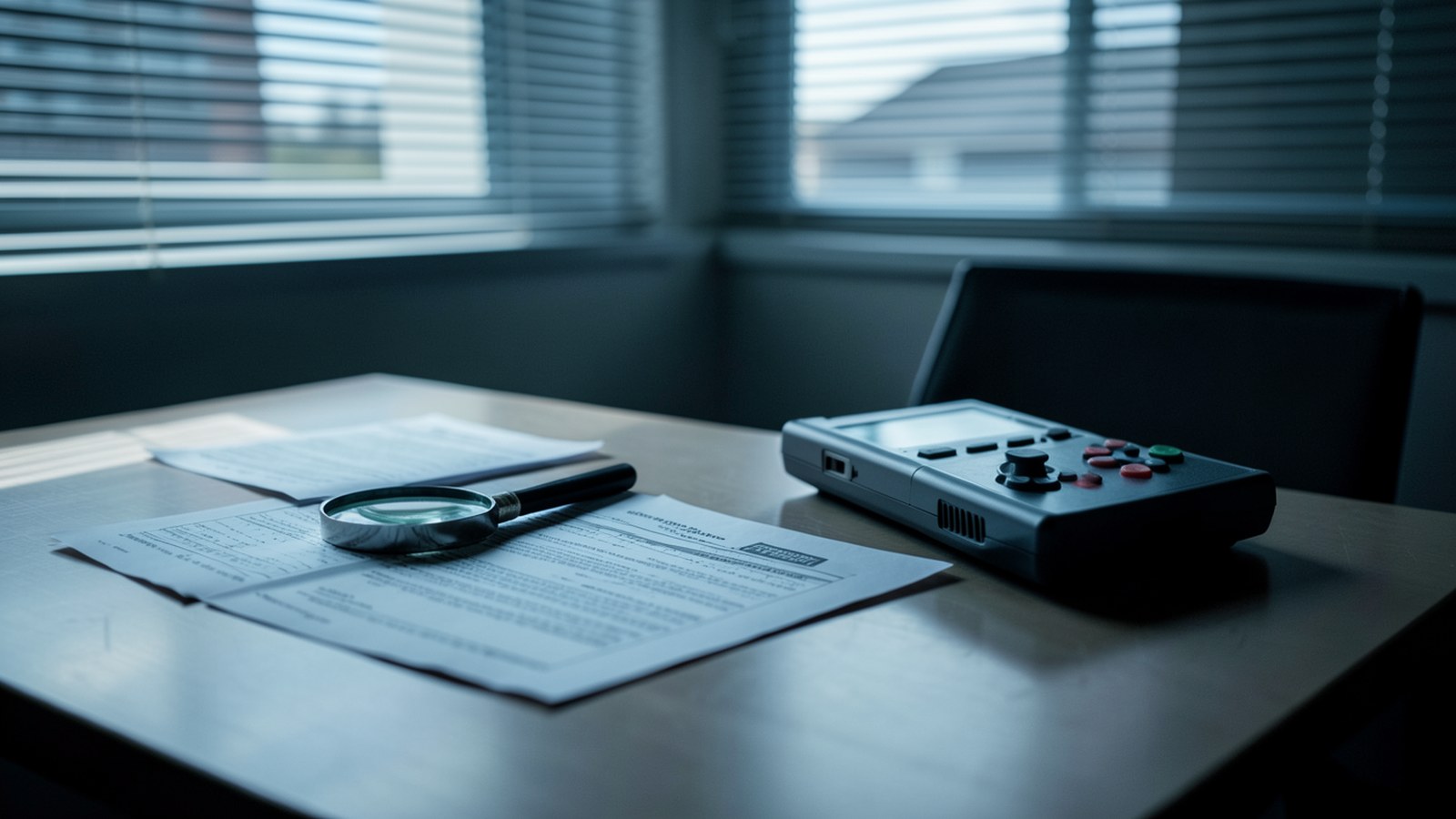
On 2 May 2024, Swedish authorities refused entry to a consignment of game consoles at the border. One of the four product types in the decision was an Anbernic RG353VS — a vertical retro handheld that Anbernic had been selling since 2022 at roughly €90.
The reason was not copyright, and it was not piracy. It was the solder. Sweden's laboratory analysis found lead at up to 28% by weight inside the device, against a legal ceiling of 0.1% (alert A12/01492/24).
Three more console types were refused under the same decision — ps2-x6 (51% lead), ps2-x80 (20%) and Project X ps2-ps5 (48%), PS2-shaped emulation boxes of the kind sold by the thousand on marketplaces. All four were notified to the European Union's Safety Gate database on 4 and 6 June 2024, all four by Sweden, all four for the same reason: the solder contains lead at 200 to 510 times the permitted concentration.
That cluster is not a one-off. It is the densest point in a record that nobody in the games press has ever tabulated.
What the alert record contains
Safety Gate is the EU's rapid alert system for dangerous non-food products. It publishes a weekly report every Friday; 607 of them cover the period from January 2015 to 6 November 2026, containing 31,670 individual alerts.
Filtering all 31,670 for products described as game consoles, handhelds, controllers or gamepads returns 20 alerts. They divide cleanly:
- 16 are hazardous-substances cases. Every single one was filed by Sweden (14) or Finland (2).
- 10 of the 16 were refused at the Swedish border — the measure is recorded as "Import rejected at border".
- Three were recalls from end users; three were withdrawals from the market.
- The remaining four are not substances cases: a 2017 Hyperkin Retron with uninsulated plug pins, two UK mini-console notifications in 2020 and 2021, and a choking risk on a toy console notified by France in October 2026.
Three further alerts that a loose keyword search would sweep in are excluded. A Cypriot notification from 2017, a Slovak one from October 2025 and a Luxembourg one from August 2026 are all products called "electronic game"; the latter two are "quick push" fidget toys. None is game hardware. The exclusion matters: it is the difference between a claim that survives checking and one that does not.
The 16 substance cases, in order:
| Date | Case | Product | Lead measured | Measure |
|---|---|---|---|---|
| 2015-12-22 | A12/1742/15 | "Retro SNES" controller | — (SCCPs 1.9% in cable) | Recall |
| 2017-10-31 | A12/1515/17 | NES USB controller | — (SCCPs 4.3%) | Recall |
| 2018-01-20 | A12/0088/18 | SNES controller | — (SCCPs 5.3%) | Recall |
| 2023-11-09 | A12/02708/23 | Nintendo Wii controller | 44% | Border refusal |
| 2023-11-09 | A12/02709/23 | Nintendo Wii controller | 22% | Border refusal |
| 2023-11-21 | A12/02837/23 | White Shark Phanteon gamepad | 68% | Withdrawal |
| 2024-05-22 | A12/01395/24 | N64-style controller | 19% | Border refusal |
| 2024-06-04 | A12/01493/24 | ps2-x6 console | 51% | Border refusal |
| 2024-06-04 | A12/01492/24 | Anbernic RG353VS | 28% | Border refusal |
| 2024-06-04 | A12/01501/24 | ps2-x80 console | 20% | Border refusal |
| 2024-06-06 | A12/01503/24 | Project X ps2-ps5 | 48% | Border refusal |
| 2024-10-03 | A12/02789/24 | 4Games Doubleshock 4 | 36.63% (+ cadmium) | Border refusal |
| 2025-11-11 | SR/03999/25 | Wireless controller | 60% (+ DEHP, SCCPs) | Withdrawal |
| 2026-06-12 | SR/01754/26 | Wii U Pro wireless gamepad | 47% | Border refusal |
| 2026-06-20 | SR/01757/26 | "Cables for Wii U Pro" | 4% | Border refusal |
| 2026-10-29 | SR/03094/26 | Tongxinyi mini console | — (cadmium 0.4%) | Withdrawal |
The trend is not decaying. Three of the sixteen were published in 2026, including two border refusals in June and a distributor withdrawal in October.
The machine behind the alerts
Sweden is not finding these by accident. The country's chemicals agency, Kemikalieinspektionen (KEMI), runs two programmes that intersect exactly here: an annual laboratory sweep of cheap home electronics bought from webshops, and a standing border partnership with Swedish Customs, Tullverket.
The overlap is documented, not inferred. KEMI's supervision report for 2023–2024 lists, line by line, the products it tested, the retailer that sold them, and the substance found. One line reads: "White Shark Trådlös Spelkontroll Phanteon, GH1495 / GPW-2021, Lowwi AB, Bly" — lead. That is the same model number, from the same Swedish retailer, as alert A12/02837/23, which records lead at 68% by weight and a withdrawal from the market in November 2023.
KEMI's 2025 report contains a PS4 charging stand and a "Gamepad Controller" sold by the Swedish retailer wePACK AB, both failing on lead; the charging stand on cadmium as well.
The programme's scale is growing faster than the gaming cases suggest:
- In 2024, KEMI and Customs banned 137 product types of electrical goods from the Swedish market; the goods were re-exported or destroyed.
- In 2025, the same partnership banned 293 product types, covering more than 43,000 individual items.
- In the agency's laboratory sweeps, 66 of 177 products (37%) tested in 2024 contained restricted substances above the limit, 60 of them lead. In 2025 the figures were 63 of 209 (30%), 59 of them lead.
- Of the products that failed the RoHS limits, 91% in the 2024 sweep and 83% in the 2025 sweep carried a CE mark anyway. KEMI's own conclusion: products that are wrongly CE-marked "risk eroding confidence in the CE mark".
Those are the agency's numbers, published in Swedish and, as far as this desk can establish, never reported in English in a games-industry context.
What 68% lead actually means
Directive 2011/65/EU — RoHS 2 — restricts lead to 0.1% by weight in any homogeneous material (Annex II). Cadmium's limit is 0.01%.
A solder alloy at 60–68% lead is not a marginal exceedance or an accounting error. It is ordinary tin-lead solder, the mix the electronics industry used for most of the twentieth century and which Europe banned in 2006. A device at 68% is not "close to the line"; the line is not visible from there.
It is equally important to say what this is not. KEMI states plainly that the substances it finds "in the normal case involve no acute risks for the user" — lead inside a sealed handheld is not a poisoning hazard to the person holding it. The harm is at end of life: lead leaches from e-waste, and the EU restricted it in electronics precisely because of the quantities involved and the way cheap electronics are discarded.
That distinction matters for how the story should be read. This is not "your handheld is poisoned". It is: an entire product category is being manufactured to a standard Europe outlawed in 2006, is entering the EU with conformity marks it has not earned, and is caught only when a Swedish laboratory happens to open the box.
The American gap
The same devices are sold in the United States. Anbernic's own store ships worldwide, and the Entertainment Software Association's October 2026 submission to the US Trade Representative records that its products are sold "through Amazon and eBay as well as its own store".
What happens to a 28%-lead handheld when it reaches an American port? Nothing in particular. The United States has no federal equivalent of RoHS: no statute sets a lead limit for solder in consumer electronics. The Consumer Product Safety Commission's jurisdiction runs to product hazards, not to substance content in general-use electronics. There is no American border test for this, and no American alert system that would publish the result.
The recall record bears that out. CPSC's public database contains 8,370 recalls dating back to 2000. Searching all of them for video-game hardware returns a handful of accessory recalls and no console: a 2005 AC adaptor for the slim PlayStation 2, Nintendo's 2006 Wii wrist-strap replacement programme, a 2008 LeapFrog battery and charging station, and a 2017 recall of PDP's Xbox One controller chargers. Nothing in the database concerns a console or a handheld, back to its first entry in 2000.
No handheld console, no mini console, no retro emulation device has ever been recalled in the United States. That is not because none has failed a test; it is because no American agency runs the test.
The case against this story
Three arguments deserve to be made against it, and two of them land.
First: enforcement is not prevalence. Sweden notifies more than most member states — 2,107 of the 31,670 alerts in this dataset, or 6.7% — and 21% of all electrical-equipment alerts. Its 14 gaming notifications — 70% of the twenty — may measure Swedish diligence rather than Chinese solder. A country that never tests finds nothing. This is correct, and it means the sixteen cases are a floor, not a rate.
Second: the absolute numbers are small, and other regulators do act — just not on this. Ten refused consignments since November 2023 is not an epidemic. No first-party console — nothing from Nintendo, Sony or Microsoft — has ever appeared in this category; the alerts concern clones, third-party pads and unbranded imports. Britain's product-safety regulator, for instance, recalled an unbranded 620-in-1 mini console in 2021, but for electric shock and fire, not for what was in its solder. Anyone reading this as a story about PlayStation or Switch has misread it.
Third: the concentrations are not in dispute at all. Every figure above is the notifying authority's own measurement, published with a case number and a legal basis, and the underlying directive is public. There is no interpretive leap between the document and the sentence.
What survives all three objections is narrower and harder: Europe's only sustained hazardous-substances enforcement against game hardware is Nordic, it is accelerating, the concentrations run from 190 to 680 times the legal limit, and the United States has no instrument that would produce a comparable number at all.
What to watch
- Whether 2026 becomes the record year. Sixteen substance cases in total: six of them were published in 2024 and three in 2026, with two months of the year left.
- Whether online marketplaces become the enforcement point. Several of the recent measures are "removal of this product listing by the online marketplace" rather than a border refusal — the same shift the EU's Digital Services Act and General Product Safety Regulation are pushing.
- Whether KEMI keeps the capacity. The agency announced 38 redundancies in June 2024 against a SEK 35 million budget gap, then more than doubled its border bans the following year. Whether that holds is a budget question, not an editorial one.
- Whether any US state moves. Absent a federal statute, the only route to an American equivalent runs through state legislatures. None has yet restricted lead in electronics solder.
Sources
Primary — EU Safety Gate alert records
- A12/01492/24 — Anbernic RG353VS, lead 28%, import rejected at border, Sweden
- A12/01493/24 — ps2-x6 console, lead 51%
- A12/01501/24 — ps2-x80 console, lead 20%
- A12/01503/24 — Project X ps2-ps5, lead 48%
- A12/02789/24 — 4Games Doubleshock 4, lead 36.63% and cadmium
- A12/02837/23 — White Shark Phanteon gamepad, lead 68%
- SR/03999/25 — wireless controller, lead 60%, DEHP, SCCPs
- SR/01754/26 — Wii U Pro wireless gamepad, lead 47%
- SR/03094/26 — Tongxinyi mini console, cadmium 0.4%
- Safety Gate weekly report index (XML, 2005–present) — the 607 weekly reports covering 2015–2026 from which the 31,670-alert corpus was built
Primary — Swedish enforcement documents
- Tillsyn 9/24: Tillsyn av hemelektronik 2023–2024 — 177 products tested, 66 failures, 91% of failures CE-marked; product table naming the White Shark Phanteon
- Tillsyn 5/26: Tillsyn av hemelektronik 2025 — 209 products, 63 failures, 83% CE-marked
- Tillsyn 7/25: Tullkontroller 2024 — 137 electrical product types banned
- Tillsyn 9/26: Tullkontroller 2025 — 293 product types, more than 43,000 items banned
Primary — law and US comparator
- Directive 2011/65/EU (RoHS 2), Annex II — lead limit 0.1%, cadmium 0.01% by weight in homogeneous materials
- CPSC recall database, RestWebServices API — 8,370 recall records, 2000–2026
- OPSS Product Recall: 620-in-1 Classic Mini Games Console (2012-0209) — UK recall for electric shock and fire
Secondary — product and market context
- Notebookcheck, Anbernic RG353VS launch pricing
- APPLiA, summary of KEMI's 2024 home-electronics report
Evidence note. Everything in the table, the ten border refusals, the sixteen cases, the 68% figure, the 137 and 293 product-type bans, the 43,000 items, the 177/209 sample sizes, the 66/63 failures, the 91%/83% CE-mark figures and the four CPSC accessory recalls is an observed fact taken directly from the cited regulator records. The link between KEMI's laboratory programme and the Swedish Safety Gate notifications is observed for the White Shark Phanteon, where the model number, retailer and substance match across both documents, and inferred for the remaining border refusals, which share the notifying country, the legal basis and the measure type but do not name the inspecting authority. The claim that no US agency tests for this is an inference from the absence of any such alert in the CPSC record and the absence of a federal substance limit; it is not a statement that no American laboratory has ever measured lead in a console.