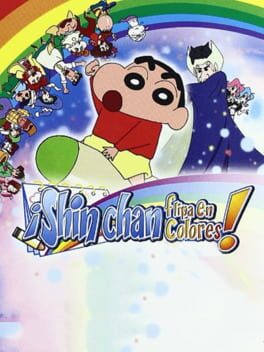
2007 •Nintendo DS
During the game, Shin chan will have to rescue all of Kasukabe from Tabu, who is eating everyone's sleep and Shin Chan will have to avoid him to wake...

GPD G7 by GamePad Digital, Horizontal retro handheld, running Android 4.2, powered by RockChip RK3188, priced around Discontinued
Marketplace rows use affiliate-friendly links where available. Average price stays based on the console database, not live per-store pricing.
| Store | Price |
|---|---|
|
Amazon
Amazon search results
|
Discontinued |
|
AliExpress
AliExpress search results
|
Discontinued |
Affiliate disclosure and terms are linked in the footer.
Broad emulation range
This is a data-grounded review of GPD G7, built around the hardware, the compatibility grades, the price band, and the devices most likely to tempt you away from it.
GPD G7 is not trying to win every argument at once; its appeal lives in the balance between emulation comfort, day-to-day usability, and whether its price still feels sane.
Before the review gets opinionated, here is the clean spec picture. This table is the reality check that keeps the rest of the write-up grounded.
| Category | Details |
|---|---|
| Brand | GamePad Digital |
| Form factor | Horizontal |
| Operating system | Android 4.2 |
| Overall performance | ⭐️⭐️⭐️⭐️½ |
| SoC | RockChip RK3188 |
| CPU | Cortex-A9, 4 Cores, and 1.6 GHz - 1.8 GHz |
| GPU | Mali-400 MP4, 4 Cores, and 533 MHz |
| Price | Discontinued |
If this review pulls you in, the fastest next rabbit hole is JXD S7300C and GPD G58, because those are the products most likely to clarify whether GPD G7 is your real match or just your current curiosity.
The heart of the machine is the RockChip RK3188. CPU duties are handled by Cortex-A9. Graphics are handled by Mali-400 MP4. The sheet rates the overall performance at ⭐️⭐️⭐️⭐️½, or roughly 4.5 on the normalized scale.
The CPU side is described with 4 Cores, 4 Threads, and 1.6 GHz - 1.8 GHz, which is more useful than brand names alone because it hints at how much headroom the handheld should have before emulator tuning gets annoying. On the graphics side, 4 Cores, 533 MHz, and ARM helps sketch the ceiling for heavier systems, upscale experiments, and shader curiosity.
GPD G7 looks strongest with Game Boy (A), NES (A), Sega Genesis (A), Game Boy Advance (A), Super Nintendo (A), and PlayStation 1 (A), which gives the review something more tangible than a vague "good for retro" verdict.
The middle tier of compatibility, including Dreamcast (C) and PSP (C), is where the buyer needs some honesty. These are usually the systems that separate a casual dabbler from a user who is happy tweaking emulator settings, testing cores, or accepting the occasional rough edge.
GPD G7 does not publish a perfect battery-and-cooling story, but daily usability still shows up in the surrounding physical details.
Portability is more than a number on a scale; it is the relationship between shape, battery confidence, hand comfort, and how willingly the device leaves the house. Buyers often underestimate how much daily affection is driven by the little things: where the ports sit, how the shell feels, and whether the handheld seems built for real use instead of product photos.
The port and expansion picture is part of the hidden quality of a handheld. A device can look attractive until you realize the storage, charging, or output setup keeps boxing you into narrower habits.
GPD G7 is currently tracked around Discontinued and lands in the Discontinued pricing band. Price does not just change whether a device feels affordable. It changes what kinds of flaws buyers are willing to forgive.
Availability is part of the value story too. A strong handheld with sketchy storefronts or inconsistent launch timing can still become a frustrating buy.
Every handheld makes tradeoffs somewhere, even when the spreadsheet leaves them unstated. The smartest shortlist is usually the one that sees the flaw clearly and decides it is either acceptable or disqualifying before the credit card comes out.
| Console | Angle | Price | Performance | Why Click Through |
|---|---|---|---|---|
JXD S7300C JinXing Digital | Better Value | Discontinued | ⭐️⭐️⭐️⭐️½ | same operating system, horizontal layout, tracked around Discontinued. |
GPD G58 GamePad Digital | Better Value | Discontinued | ⭐️⭐️⭐️⭐️½ | horizontal layout, tracked around Discontinued, rated ⭐️⭐️⭐️⭐️½. |
GPD G5A GamePad Digital | Better Value | Discontinued | ⭐️⭐️⭐️⭐️½ | horizontal layout, tracked around Discontinued, rated ⭐️⭐️⭐️⭐️½. |
JXD S5800 JinXing Digital | Closest Match | Discontinued | ⭐️⭐️⭐️½ | same operating system, horizontal layout, tracked around Discontinued. |
GPD G7 becomes much easier to judge once it is forced into the same room as JXD S7300C, GPD G58, and GPD G5A. This is where a vague impression turns into a real buying decision, because each nearby rival throws a different kind of pressure on the table.
GPD G7 versus JXD S7300C is interesting because better value is the obvious angle. Compared with GPD G7, JXD S7300C makes the more obvious play for readers who care about better value. JXD S7300C is tracked around Discontinued. Its overall rating is ⭐️⭐️⭐️⭐️½. More importantly, gPD G7 versus GPD G58 is interesting because better value is the obvious angle. GPD G58 sits close enough to GPD G7 to make the comparison meaningful, but different enough to sharpen the buying decision. GPD G58 is tracked around Discontinued. From another angle, gPD G7 versus GPD G5A is interesting because better value is the obvious angle. GPD G5A sits close enough to GPD G7 to make the comparison meaningful, but different enough to sharpen the buying decision. GPD G5A is tracked around Discontinued.
Comparison is the antidote to spec-sheet hypnosis. Once you stack the neighbors side by side, you stop asking which one is objectively best and start asking which one is best for your habits.
GPD G7 is best framed as a machine for players who want a balanced handheld that can stretch beyond the basics. That may sound obvious, but it is the difference between buying a handheld that becomes a habit and one that turns into a drawer resident.
The horizontal shape matters here because it changes comfort, portability, and the kind of nostalgia the device leans into. The fact that it runs Android 4.2 also affects what kind of setup work, app ecosystem, and tinkering ceiling buyers should expect.
Even without a perfect release story, the hardware still reveals its lane. Context matters because buyers are not comparing isolated products; they are comparing moments in the market.
GPD G7 is lighter on explicit display detail, which makes the ergonomics and control story even more important when deciding whether it belongs on a shortlist.
Control detail is sparse in the sheet, but that absence is itself a signal: it means buyers should lean harder on form factor, brand reputation, and comparative market positioning. If the screen is what sells a handheld in screenshots, the controls are what decide whether it earns repeat sessions.
Retro display choices are always a negotiation. Some buyers want sharp all-purpose flexibility, others want a screen that flatters the systems they actually play most. Good reviews should make that tradeoff visible instead of pretending every resolution solves every problem.
GPD G7 leaves the strongest impression when you frame it as a recommendation for players who want a balanced handheld that can stretch beyond the basics. That is also what turns the buying advice from noise into something useful.
Broad emulation range is not just a catchy label here. It is the cleanest shorthand for why this device deserves attention. The compatibility profile around Game Boy (A), NES (A), Sega Genesis (A), and Game Boy Advance (A) gives it a concrete identity.
If the device sparks your interest, the smartest next click is usually JXD S7300C, followed by GPD G58, because that is where the shape of the market around it comes into focus. That is what a good review should do: not close the conversation, but sharpen the next choice.
Games shown here match systems this handheld can run at a B grade or better.
2007 •Nintendo DS
During the game, Shin chan will have to rescue all of Kasukabe from Tabu, who is eating everyone's sleep and Shin Chan will have to avoid him to wake...

1998 •PlayStation 1
...Iru! takes place in a high school with a large mechanical clock in the center. You control an upper classman who, along with his fellow students an...
1998 •PlayStation 1
The sixth in the Koshien series. It is a high school baseball simulation which chooses one from 40 000 high schools from Hokkaido in the north to Okin...
1999 •PlayStation 1, PlayStation 3, PSP
The final Playstation 1 release in the Koushien series
2016 •Super Nintendo
Mario goes on another quest to save the kingdom. What obstacles will he be facing this time? 'the (also known as Coronation Day) is a Horror themed S...
2019 •Sega Genesis
A ROM hack/mod for Sonic the Hedgehog which changes Sonic for Shadow the Hedgehog. Although a previous mod with the same purpose exists, this one adds...
2023 •Super Nintendo
An unofficial horror mod for a castle level in Super Mario World. There are multiple endings for the player to discover.
2000 •PlayStation 1, PlayStation 3, PSP
A direct sequel to 1999's mahjong game for kids 0 Kara no Mahjong: Mahjong Youchien - Tamago Gumi.
1998 •PlayStation 1, PlayStation 3, PSP
This is a mahjong game specially designed for young players to learn how to play mahjong. The game features several game modes and a lot of different...
1999 •PlayStation 1, PlayStation 3, PSP
This is a shogi game that features 5 different kind of boards, a complete tutorial and a dictionary in Japanese language, different vs modes (also a 2...
2016 •Nintendo Entertainment System
Based on a hit internet phenomenon, 0-to-X is an addictive puzzler developed by nemesys. In addition to tile mashing fun, the game features an amazing...
2000 •PlayStation 1
In 007 Racing you can get behind the wheel of James Bond's car. You must complete missions which range from collecting an object and getting out aliv...