Android High-End
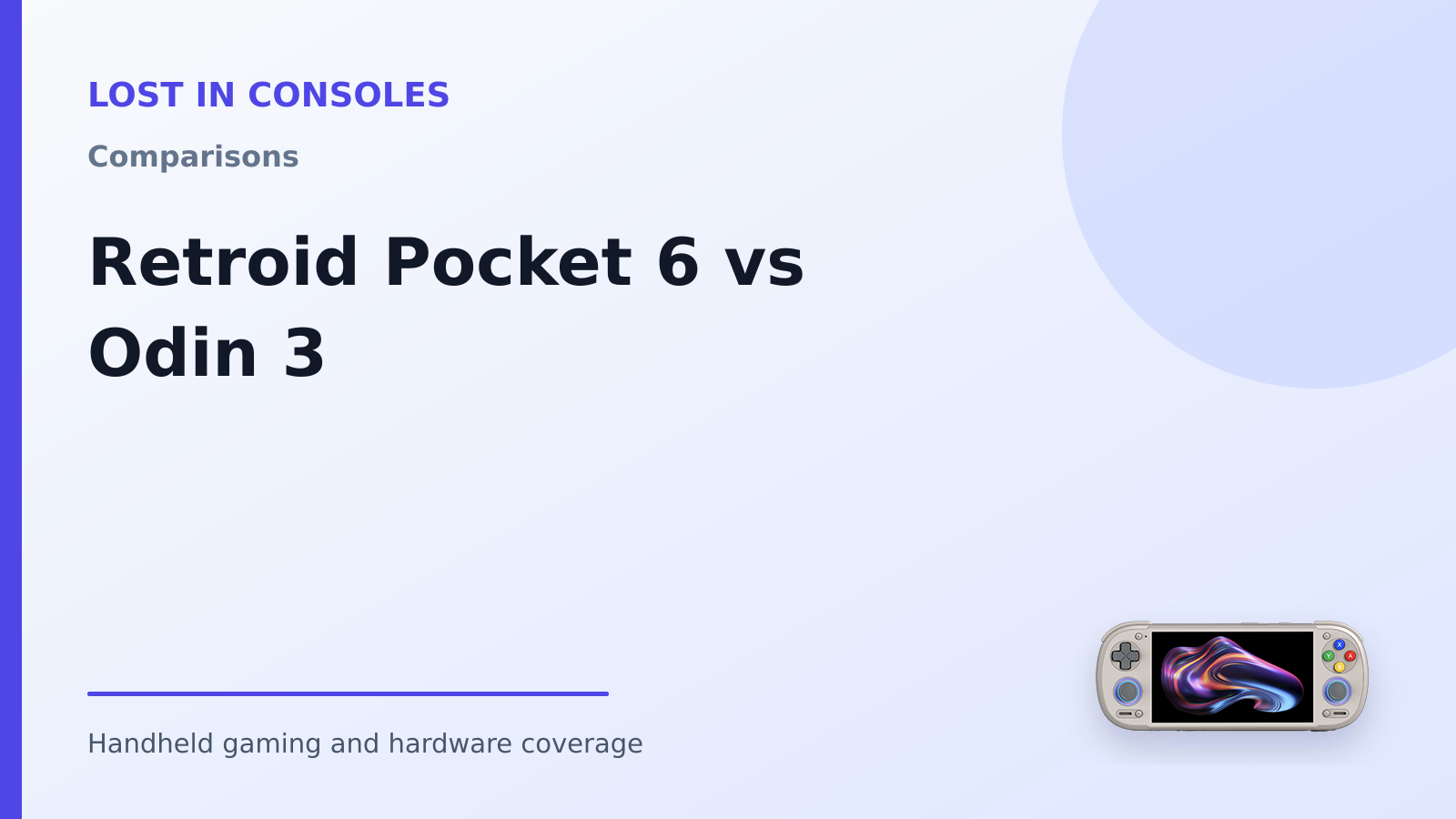
Retroid Pocket 6 vs Odin 3
Retroid Pocket 6 vs Odin 3: a head-to-head comparison of chipset, screen, battery, and which high-end Android handheld is the better buy for GameCube, Wii, and PS2.


Odin 3
AYN Technologies · 7/10 · B+
The Odin 3 takes the crown for top-tier PS2, Wii, and GameCube emulation with the stronger chipset and the biggest battery, but it costs a premium. Choose the Retroid Pocket 6 if you want near-flagship performance at a lower price.
| Spec | Retroid Pocket 6 | Odin 3 |
|---|---|---|
| Brand | Retroid / Moorechip | AYN Technologies |
| Form Factor | Horizontal | Horizontal |
| Operating System | Android 13 | Android 15 |
| Chipset | Qualcomm Snapdragon 8 Gen 2 | Qualcomm Dragonwing Q8 (Snapdragon 8 Elite) |
| RAM | 8 GB / 12 GB LPDDR5X | 8 / 12 / 16 / 24 GB LPDDR5X |
| Screen | 5.5 inch | 6.0 inch |
| Resolution | 1920 x 1080 | 1920 x 1080 |
| Battery | 6000 mAh | 8000 mAh |
| Price | $209 - $279 (Hover for detailed prices) | $299 - $479 |
Retroid Pocket 6
- ✓Stronger chipset for the hardest GameCube/PS2/Wii titles
- ✓Largest battery in its class
- ✓Best-in-class screen for Android content
- ✕Premium price tag
- ✕Heavier and bulkier than the Pocket 6
Odin 3
- ✓Near-flagship PS2/GameCube performance for less
- ✓Lighter and easier to travel with
- ✓Great value-per-dollar in the high-end class
- ✕Less headroom than the Odin 3 on the very hardest titles
- ✕Smaller battery than the Odin 3
Buying Links
When you buy through links on this site, Lost In Consoles may earn a commission at no extra cost to you.
The Retroid Pocket 6 and Odin 3 are two of the strongest Android handhelds you can buy right now. Both clear the full A-grade bar for GameCube, Wii, and PlayStation 2, and both are built around a horizontal layout with a big AMOLED screen. The real question is whether the Odin 3's extra power and larger display are worth the step up in price.
Chipset and emulation ceiling
The Retroid Pocket 6 runs a Qualcomm Snapdragon 8 Gen 2 with an Adreno 740 GPU and 8 or 12 GB of LPDDR5X RAM. The Odin 3 steps up to the Snapdragon 8 Elite (Qualcomm Dragonwing Q8) with an Adreno 830 GPU and up to 24 GB of LPDDR5X. The 8 Elite is the newer, faster silicon, and it shows in the harder titles.
On our compatibility scale both devices grade Game Boy, NES, Genesis, GBA, SNES, PS1, N64, Dreamcast, PSP, Saturn, GameCube, Wii, 3DS, and PS2 at A-level. The difference is headroom: the Odin 3 reaches Wii U at A and Nintendo Switch at B, while the Pocket 6 sits at A- for Wii U and C+ for Switch. If you want to push into Switch emulation, the Odin 3 is the safer pick.
Screen and feel
The Pocket 6 has a 5.5 inch 1920x1080 AMOLED touchscreen. The Odin 3 has a larger 6.0 inch 1920x1080 AMOLED touchscreen. Both are sharp and vivid, but the Odin 3's extra half inch makes a real difference for widescreen GameCube and PS2 titles and for Android games with small text.
Battery and price
The Pocket 6 carries a 6000 mAh battery, while the Odin 3 carries a larger 8000 mAh battery. On price, the Pocket 6 sits around $209 to $279, while the Odin 3 runs $299 to $479. That is a meaningful gap, and it is the main reason to think twice before reaching for the Odin 3.
Which should you buy?
Choose the Retroid Pocket 6 if you want the best value in high-end Android emulation. It clears the A-grade bar for GameCube, Wii, and PS2 for noticeably less money, and the 5.5 inch screen is still excellent. Choose the Odin 3 if you want the most headroom, the bigger 6.0 inch display, the larger battery, and the ability to reach into Switch emulation. The best handheld is the one that matches the systems you actually play and the budget you are comfortable with.