Buying Guides
Best Vertical Retro Handhelds
The best vertical retro handhelds for Game Boy, GBA, SNES, PS1, N64, and Dreamcast, ranked by real compatibility grades and price.
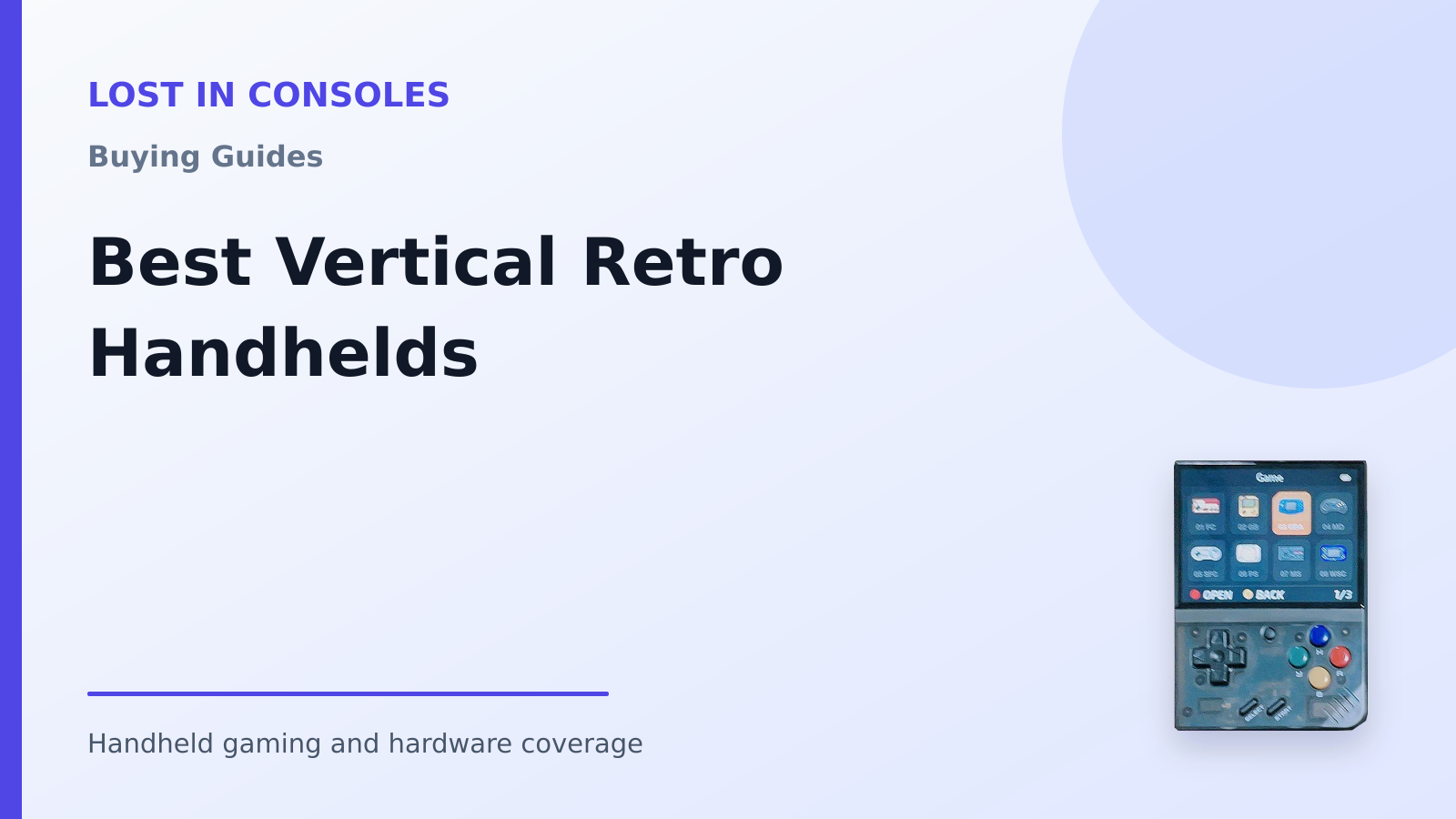
A vertical retro handheld is the layout most people picture when they think of a Game Boy. The screen sits above the controls, the whole device fits in a palm, and the form factor makes it a genuinely pocketable daily carry. The tradeoff is that the vertical layout narrows the choices: fewer devices use it, so the differences between them matter more.
The good news is the vertical lineup now covers the full range, from a $40 pocket device to systems that run N64 and Dreamcast cleanly. The key is matching the device to the libraries you actually play.
Best budget vertical: Miyoo Mini
The Miyoo Mini is the smallest vertical handheld worth buying. It runs Game Boy, GBC, GBA, SNES, and PlayStation 1 at an A grade, and costs around $52. The 2.8-inch screen is tiny, so it is best for short sessions and pocket carry rather than long RPG marathons. If you want the most portable vertical device possible for the core libraries, this is it.
Best all-rounder: Miyoo Mini Plus
The Miyoo Mini Plus is the safest vertical buy under $70. It matches the Mini on compatibility — A on GB, GBC, GBA, SNES, and PS1 — but bumps the screen to a much more comfortable 3.5 inches. It costs about $70 and the larger display makes it usable for longer sessions. The Onion OS firmware support is excellent. If you want one vertical device that covers the core libraries without compromise, this is the pick.
Best value under $100: Anbernic RG-35XX Plus
The RG-35XX Plus is the vertical device that reaches furthest for the money. It runs GB, GBC, GBA, SNES, and PS1 at A, then adds N64 at B and Dreamcast at B for about $64. That is real headroom the Miyoo options do not have. The 3.5-inch screen and polished Linux build make it the best value vertical in the range if you want to play a little past PS1.
Best for a bigger screen: Anbernic RG-40XXV
The RG-40XXV is the vertical device for people who want a larger display without leaving the Game Boy layout. It runs the core libraries at A, adds N64 at B and Dreamcast at B, and costs around $60. The 4.0-inch screen is the biggest in this range, which helps for games with small text and for longer sessions. If screen size is the priority in a vertical shell, this is the pick.
Best for N64 and Dreamcast: Anbernic RG-353V
If you want to push a vertical device past PS1 comfortably, the RG-353V is the best under $120. It runs GB, GBC, GBA, SNES, and PS1 at A, adds Nintendo DS at A, and handles N64 at B+ and Dreamcast at B for about $113. It also runs PSP at B-. That makes it the vertical option with the most real-world headroom for 3D libraries while staying pocketable.
Best for high-end emulation: Anbernic RG-477V
When you want a vertical handheld that runs everything, the RG-477V is the top pick. It scores A on GB, GBA, SNES, PS1, N64, Dreamcast, PSP, Sega Saturn, and even GameCube, Wii, and PlayStation 2, and costs around $200. The 4.7-inch 1280 x 960 display is large and sharp. It is a premium price, but it is the only vertical device that clears the full A-grade bar for modern retro libraries.
Which should you buy?
Match the device to your library, not the other way around. If you mostly play Game Boy, GBA, and SNES and want maximum pocketability, the Miyoo Mini Plus is the best value. If you want N64 and Dreamcast headroom under $100, the RG-35XX Plus is the pick. If you want the biggest vertical screen, choose the RG-40XXV. If you play a lot of N64 and Dreamcast, the RG-353V is the best mid-range option. And if you want a vertical device that runs everything including GameCube and PS2, the RG-477V is worth the step up.
The rule is the same as any retro handheld: buy for the systems that are A or B on the device, and treat everything below that as a bonus. Every vertical handheld in this list clears that bar for the libraries that matter most.
Sources
- Miyoo — official product pages and specifications: www.miyoo.co
- Anbernic — official product pages and specifications: anbernic.com
- RetroArch / Libretro — frontend and core documentation: docs.libretro.com
- Emulation General Wiki — per-system compatibility and hardware reference: emulation.gametechwiki.com
- Retro Handhelds — handheld news and hardware coverage: retrohandhelds.gg
- Retro Dodo — retro handheld reviews and buying guides: retrododo.com
Method note: vertical handhelds trade screen size for pocketability and a Game Boy-style grip; specs and prices are vendor-published and change frequently. Rankings are our editorial judgement.